Showing posts with label bees. Show all posts

Friday, October 11, 2013

After NEONICOTINOIDS, EU bans another insecticide (FIPRONIL) endangering pollinators


Bees of America, please don’t take this the wrong way, but it might be time to buzz off to Europe.
The European Union will limit the use of yet another bee-endangering insecticide, part of its efforts to protect pollinators from agricultural poisons.
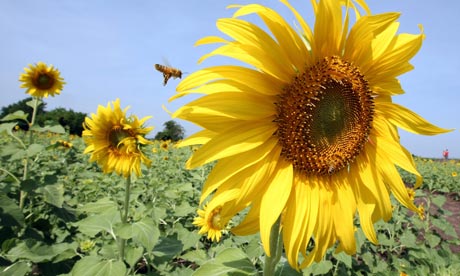
The use of fipronil, a nerve agent produced by German company BASF and widely applied by farmers to kill insect pests, will be outlawed on corn and sunflower seeds and fields across Europe. From Reuters:
The restrictions take effect from Dec. 31 but seeds which have already been treated can be sown until the end of February 2014.
The ban follows similar EU curbs imposed in April on three of the world’s most widely used pesticides, known as neonicotinoids, and reflects growing concern in Europe over a recent plunge in the population of honeybees critical to crop pollination and production.
A scientific assessment from the EU’s food safety watchdog EFSA said in May that fipronil posed an “acute risk to honeybees when used as a seed treatment for maize”.
Fipronil, mainly sold under the Regent brand name in Europe, may still be used on seeds sown in greenhouses, or leeks, shallots, onions and other vegetables that are harvested before they flower, posing a low risk to foraging bees.
The U.K. and the U.S. have both been reluctant to restrict sales of pesticides that pose a threat to bees, but the U.K. is bound by the European Union’s recent bans and restrictions, while the U.S., of course, is not. Beekeepers and environmentalists in the U.S. are currently suing the EPA in an effort to institute similar bans here.From The Guardian:
Bees and other pollinators are essential in the growing of three-quarters of the world’s crops, but have seen serious declines in recent decades due to habitat loss, disease and pesticide use. In Tuesday’s vote, only the UK, Slovakia and the Czech Republic abstained and only Spain — the biggest user of fipronil — and Romania voted against. The UK was also one of eight of the 27 EU member states that unsuccessfully opposed the EC neonicotinoid ban.
“The UK abstained from the vote as there were concerns that the proposals were not based on sound scientific evidence,” said a [spokeswoman for the Department for Environment, Food and Rural Affairs]. “Fipronil is not used in any authorised pesticide in the UK so this ruling will have little impact [here].”
Paul de Zylva, of Friends of the Earth, welcomed the “leadership” of the European commission but added: “Yet again the UK’s pesticide testing regime has proven to be unfit for purpose. It’s disappointing to see the UK government abstaining from another cut and dried opportunity to protect bees.”
To the bees of America: Bon voyage.
Source: http://grist.org/news/e-u-bans-another-bee-killing-insecticide/

Monday, May 6, 2013

Bee deaths: EU to ban neonicotinoid pesticides

The European Commission will restrict the use of pesticides linked to bee deaths by researchers, despite a split among EU states on the issue.
There is great concern across Europe about the collapse of bee populations.

Neonicotinoid chemicals in pesticides are believed to harm bees and the European Commission says they should be restricted to crops not attractive to bees and other pollinators.

But many farmers and crop experts argue that there is insufficient data.
Fifteen countries voted in favour of a ban - not enough to form a qualified majority. According to EU rules the Commission will now have the option to impose a two-year restriction on neonicotinoids - and the UK cannot opt out.

The Commission says it wants the moratorium to begin no later than 1 December this year.
The UK did not support a ban - it argues that the science behind the proposal is inconclusive. It was among eight countries that voted against, while four abstained.

Wild species such as honey bees are said by researchers to be responsible for pollinating around one-third of the world's crop production.

There is heated debate about what has triggered the widespread decline in bee populations. Besides chemicals, many experts point to the parasitic varroa mite, viruses that attack bees and neglect of hives.

After Monday's vote the EU Health Commissioner, Tonio Borg, said "the Commission will go ahead with its text in the coming weeks".

What exactly are Neonicotinoids?

  • Nicotine is not just lethal to humans in the form of cigarettes, but the chemical is also extremely toxic to insects
  • Neonicotinoid pesticides are new nicotine-like chemicals and act on the nervous systems of insects, with a lower threat to mammals and the environment than many older sprays
  • Pesticides made in this way are water soluble, which means they can be applied to the soil and taken up by the whole plant - they are called "systemic", meaning they turn the plant itself into a poison factory, with toxins coming from roots, leaves, stems and pollen
  • Neonicotinoids are often applied as seed treatments, which means coating the seeds before planting.
"I pledge to do my utmost to ensure that our bees, which are so vital to our ecosystem and contribute over 22bn euros (£18.5bn; $29bn) annually to European agriculture, are protected."
Greenpeace EU agriculture policy director Marco Contiero said Monday's vote "makes it crystal clear that there is overwhelming scientific, political and public support for a ban.
"Those countries opposing a ban have failed."

An EU vote last month was inconclusive, so the Commission proposal went to an appeals committee on Monday - and again the countries were split on the issue.
Some restrictions are already in place for neonicotinoids in France, Germany, Italy and Slovenia.
The three neonicotinoids are clothianidin, imidacloprid and thiametoxam.

A report published by the European Food Safety Agency (EFSA) in January concluded that the pesticides posed a "high acute risk" to pollinators, including honeybees.
However, it added that in some cases it was "unable to finalise the assessments due to shortcomings in the available data"


 Intensive lobbying
There was ferocious lobbying both for and against in the run-up to Monday's vote, the BBC's Chris Morris reports from Brussels.

Nearly three million signatures were collected in support of a ban. Protesters against neonicotinoids rallied in Westminster on Friday.

Campaign organiser Andrew Pendleton of the environmental group Friends of the Earth said "leading retailers have already taken action by removing these pesticides from their shelves and supply chains - the UK government must act too".

Chemical companies and pesticide manufacturers have been lobbying just as hard - they argue that the science is inconclusive, and that a ban would harm food production.

The UK government seems to agree with the industry lobby. It objected to the proposed ban in its current form. The chief scientific adviser, Sir Mark Walport, has said restrictions on the use of pesticides should not be introduced lightly, and the idea of a ban should be dropped.
The EU moratorium will not apply to crops non-attractive to bees, or to winter cereals.
It will prohibit the sale and use of seeds treated with neonicotinoid pesticides.
And there will be a ban on the sale of neonicotinoids to amateur growers.

There have been a number of studies showing that the chemicals, made by Bayer and Syngenta, do have negative impacts on bees.

One study suggested that neonicotinoids affected the abilities of hives to produce queen bees. More recent research indicated that the pesticides damaged their brains.
But the UK Department for Environment, Food and Rural Affairs (Defra) argues that these studies were mainly conducted in the laboratory and do not accurately reflect field conditions.

Source: bbc.news.uk 29.04.13

Sunday, March 31, 2013

EU proposes to ban insecticides linked to bee decline

Three neonicotinoids, the world's most widely used insecticides would be forbidden across the continent for two years

After failing to get a ban in February 2013, the EU will certainly pursue its lobby to ban clothianidin, imidacloprid and thiametoxam.

Imadacloprid and Thiametoxam are marketed in Mauritius and therefore our vegetables and fruits exporters should take EU's step with concern and adapt to this new situation fast.

 A ban on 3 pesticides (nenicotinoids (NNI) - clothianidin, imidacloprid and thiametoxam) was submitted by the Commission for vote on 15 March 2013 to Member States' experts meeting at a Standing Committee on the Food Chain and Animal Health.
The Commission's proposal is a response to the European Food Safety Authority's scientific report which identified "high acute risks" for bees as regards exposure to dust in several crops such as maize, cereals and sunflower, to residue in pollen and nectar in crops like oilseed rape and sunflower and to guttation in maize.
The Commission proposed the following to Member States:
  1. amend the conditions of approval of the 3 NNI in order to restrict the use o nly to crops non attractive to bees and to winter cereals (as dust exposure during autumn is not considered a major issue).
  2. prohibit the sale and use of "seeds treated" with plant protection products containing these active substances (provision not to apply to treated seeds of plants non attractive to bees and to treated seeds of winter cereals).
  3. both measures referred to in points 1) and 2) to be implemented at the latest by 1 July 2013 (thus not affecting the forthcoming sowing season for maize).
  4. prohibit the sale and use to "amateurs". Only professional uses to remain allowed.
  5. To review of both measures by the Commission after 2 years.
    Commission to review the conditions of approval of the 3 neonicotinoids (clothianidin, thiametoxam and imidacloprid) - as soon as new information is available - to take into account relevant scientific and technical developments.
  6. Exceptions to be limited to the possibility to treat bee-attractive crops in greenhouses at any time and in open field only after flowering.
Result of the vote:
The Commission put the text to the vote and NO QUALIFIED MAJORITY WAS REACHED, either in favour or against of the text.
THE COMMISSION TAKES NOTE OF THE MEMBER STATES' RESPONSE TO ITS PROPOSAL BUT REMAINS COMMITTED TO AMBITIOUS AND PROPORTIONATE LEGISLATIVE MEASURES. 

Source: http://ec.europa.eu 

Neonicotinoid pesticides 'damage brains of bees'

Commonly used pesticides are damaging honey bee brains, studies suggest.

Scientists have found that two types of chemicals called neonicotinoids and coumaphos are interfering with the insect's ability to learn and remember.

Experiments revealed that exposure was also lowering brain activity, especially when the two pesticides were used in combination.

The research is detailed in two papers in Nature Communications and the Journal of Experimental Biology.

But a company that makes the substances said laboratory-based studies did not always apply to bees in the wild.

And another report, published by the Defra's Food and Environment Research Agency (Fera), concluded that there was no link between bee health and exposure to neonicotinoids. The government agency carried out a study looking at bumblebees living on the edges of fields treated with the chemicals.

Falling numbers
Honey bees around the world are facing an uncertain future. They have been hit with a host of diseases, losses of habitat, and in the US the mysterious Colony Collapse Disorder has caused numbers to plummet.

Now researchers are asking whether pesticides are also playing a role in their decline. To investigate, scientists looked at two common pesticides: neonicotinoids, which are used to control pests on oil seed rape and other crops, and a group of organophosphate chemicals called coumaphos, which are used to kill the Varroa mite, a parasite that attacks the honey bee.

Neonicotinoids are used more commonly in Europe, while coumaphos are more often employed in the United States. 

Work carried out by the University of Dundee, in Scotland, revealed that if the pesticides were applied directly to the brains of the pollinators, they caused a loss of brain activity.
Dr Christopher Connolly said: "We found neonicotinoids cause an immediate hyper-activation - so an epileptic type activity - this was proceeded by neuronal inactivation, where the brain goes quiet and cannot communicate any more. The same effects occur when we used organophosphates.
"And if we used them together, the effect was additive, so they added to the toxicity: the effect was greater when both were present."

Another series of laboratory-based experiments, carried out at Newcastle University, examined the behaviour of the bees. The researchers there found that bees exposed to both pesticides were unable to learn and then remember floral smells associated with a sweet nectar reward - a skill that is essential for bees in search of food.

Dr Sally Williamson said: "It would imply that the bees are able to forage less effectively, they are less able to find and learn and remember and then communicate to their hive mates what the good sources of pollen and nectar are."

'No threat'
She said that companies that are manufacturing the pesticides should take these findings into account when considering the safety of the chemicals.

She explained: "At the moment, the initial tests for bee toxicity are giving the bees an acute dose and then watching them to see if they die. 

"But because bees do these complex learning tasks, they are very social animals and they have a complex behavioural repertoire, they don't need to be killed outright in order not to be affected."
The European Commission recently called for a temporary moratorium on the use of neonicotinoids after a report by the European Food Safety Authority concluded that they posed a high acute risk to pollinators. 

But 14 out of the 27 EU nations - including the UK and Germany - opposed the ban, and the proposal has now been delayed.

Ian Boyd, chief scientist at Defra, said: "Decisions on the use of neonicotinoids must be based on sound scientific evidence."

He said that the results of the Fera bumblebee study suggested that the extent of the impact might not be as high as some studies had suggested - and called for "further data based on more realistic field trials is required". 

Dr Julian Little, communications and government affairs manager at Bayer Crop Science Limited, which makes some of the pesticides, said the findings of laboratory-based studies should not be automatically extrapolated to the field.

"If you take an insecticide and you give it directly to an insect, I can guarantee that you will have an effect - I am not at all surprised that this is what you will see," he explained.
"What is really important is seeing what happens in real situations - in real fields, in real bee colonies, in real bee hives, with real bee keepers."

Source: http://www.bbc.co.uk